Can you block an area code on iPhone?
The calls all start with the same three digits, so blocking those three digits sounds like the fix. The arithmetic is the reason nobody offers it as a button.
iPhone has no documented area-code blocking setting. Apple's controls block individual numbers or contacts. Some third-party apps support number ranges; their limits vary. CallBlocker cannot block an entire North American area code. It supports up to four wildcard digits per rule, enough for one exchange prefix: 10,000 number combinations.
This guide covers iOS 26 and North American Numbering Plan numbers (the +1 country code used in the US and Canada). All Nighter Labs builds CallBlocker, an upcoming iPhone app for pattern blocking. We have included our own limits below, because they are the point: we cannot block an area code either.
Seven wildcard digits create ten million combinations.
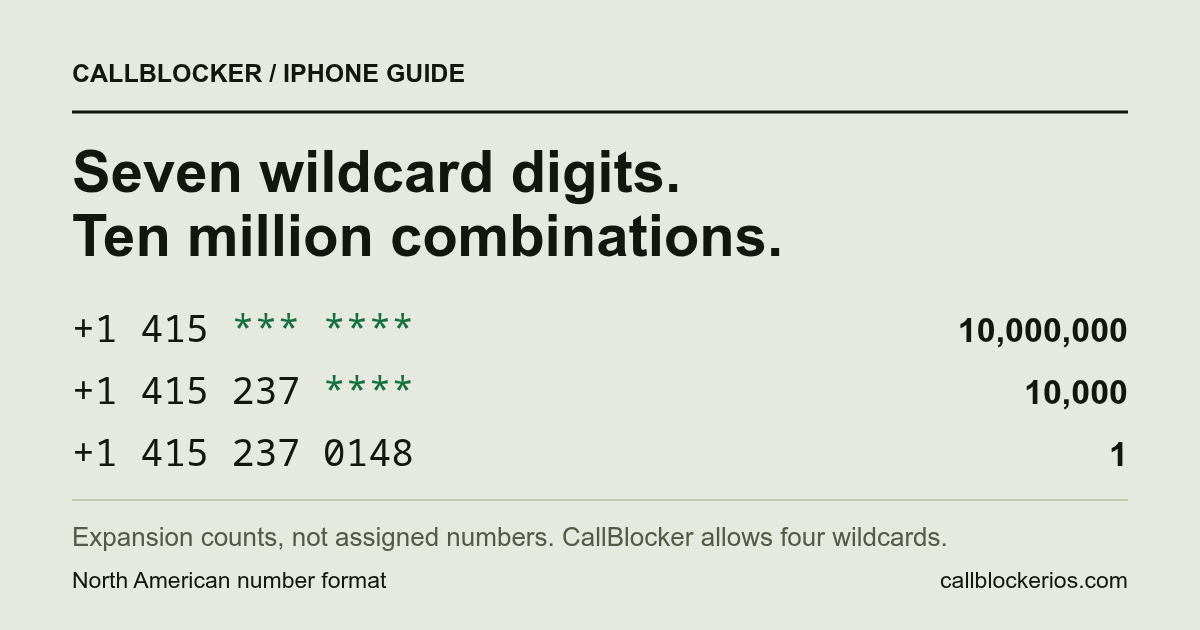
A US or Canadian number is built as country code, area code, exchange prefix and line number: +1 NPA NXX XXXX. Replacing all seven local digits with unrestricted wildcards produces 10,000,000 combinations. That is not ten million valid or assigned phone numbers: NANPA specifies that the first digit of an exchange prefix is 2–9. That reduces the structural possibilities to eight million before reserved codes and actual assignments are considered.
| Rule | Example | Wildcard combinations |
|---|---|---|
| Seven-digit wildcard expansion | +1 415 *** **** | 10,000,000 |
| Exchange prefix | +1 415 237 **** | 10,000 |
| Part of a prefix | +1 415 237 01** | 100 |
| One number | +1 415 237 0148 | 1 |
Each extra unrestricted wildcard multiplies the expansion by ten. The seven-wildcard example exceeds CallBlocker's limit and cannot be saved as a rule.
iPhone blocks numbers and contacts, not ranges.
Apple's own blocking controls are per number or per contact: you open a call in the Phone app or add an entry under blocked callers, and that entry is blocked. Apple documents the steps and states plainly that a blocked contact can still leave a voicemail, without a notification. See Apple's blocking guide.
Ranges reach the block list a different way. Apps can register a Call Directory extension, which hands iOS a prepared list of numbers to block. Apple's developer documentation describes the extension supplying that list up front, not deciding call by call. See Apple's Call Directory documentation.
A wildcard rule therefore becomes many individual entries. Broader ranges require more entries and can hit an app's capacity or a system loading error. This explains CallBlocker's limits; it does not establish a universal maximum for every iPhone blocking app.
The contact workaround is a community trick, not an Apple feature.
A widely shared workaround creates one contact, adds entries written with the country code and asterisks in place of the remaining digits, then blocks that contact. An Apple Support Communities post from July 2025 describes the method in detail for an Australian area code.
Be clear about its status before you spend an evening on it:
- Apple does not document wildcard matching in Contacts as a blocking feature, so there is no published specification for what it matches.
- It is user-reported behaviour on specific iOS versions. We have not tested it, and undocumented behaviour can change in any release.
- Even if a controlled test succeeds, it does not establish coverage of an entire area code or change the limits of voicemail blocking.
If you try it, verify it with a number you control rather than assuming it worked because the calls happened to stop that week.
The exchange prefix is the rule that fits.
Look at the numbers that keep calling. If they share the area code and the next three digits, the repeated part is the exchange prefix, and a rule covering the last four digits is 10,000 numbers.
In CallBlocker's syntax an asterisk replaces exactly one decimal digit, so that rule is written:
+14152370*** covers 1,000 numbers. +1415237**** covers 10,000.
Our limits are deliberate and worth knowing before you decide the app fits your problem:
- 10,000 numbers per rule. Four wildcards. One full exchange prefix is exactly at the cap.
- 180,000 numbers in total across every active rule. That is roughly eighteen full prefixes, not eighteen area codes.
These are CallBlocker's current limits, not Apple-published limits for every app. A whole North American area code exceeds them. Other apps may use different limits or implementations; check their documented coverage before buying.
Start with the narrowest rule that covers the calls you are actually getting. If two prefixes repeat, that is two rules, and you can remove either one when the calls move on.
Blocking a whole area code blocks the wrong people.
Caller ID does not prove where a call originated. A caller can falsify the displayed number, including making it look local — the FCC calls this neighbor spoofing. A number rule can block a call displaying a matching spoofed number, but it cannot identify the caller behind it. They can use a different displayed number outside the rule.
Meanwhile an area code is a place where real people answer phones. Your area code contains the clinic calling with a result, the school, the courier, the plumber returning your call from a mobile. A broad range can silence legitimate callers along with the unwanted calls. Start with the smallest range you can justify.
The narrower the rule, the fewer strangers it silences on your behalf. That is the whole reason to read the range before enabling it.
No usable pattern? Screen instead of widening the rule.
Sometimes the numbers share nothing. Widening a rule until it catches them is how people end up blocking their own neighbourhood. Two built-in options handle that case better:
- Screen Unknown Callers under Settings → Apps → Phone. Ask an unfamiliar caller for a reason before your phone rings, or silence unsaved numbers to voicemail. Apple describes both options and their exceptions.
- Call Filtering in the same menu, where the carrier's spam flag can silence calls the network has identified.
For US numbers, the National Do Not Call Registry reduces sales calls from businesses that follow its rules and does nothing to callers who ignore it. The FTC's registry FAQ sets out those limits.
Our companion guide compares screening, carrier filtering and pattern rules side by side: how to stop spam calls when the numbers keep changing.